About me

My name is Yun-Ao Xiao (肖云奥), a PhD student in WSGP group, NAOC. I’m working under the guidance of Prof. Hu Zou, studying stellar streams, dwarf galaxies, and the Milky Way dark matter halo, alongside the development of asteroid survey and data-processing methods.

My Research

I use wide-field imaging, astrometry, and spectroscopy to study how galaxies assemble and how objects move across the sky. My work connects Galactic archaeology with the development of survey methods and data pipelines, from tracing faint stellar structures in the Milky Way to identifying and measuring asteroids in time-domain observations.

Stellar streams and the Galactic halo

Stellar streams preserve the history of disrupted star clusters and dwarf galaxies, while their orbits trace the Milky Way’s gravitational field. I combine deep imaging, Gaia astrometry, and DESI spectroscopy to identify stream members and study their spatial, kinematic, and chemical properties. A particular focus is Palomar 5, where I use clustering methods and dynamical models to investigate the stream and constrain the structure of the Galactic dark matter halo. I am also interested in dwarf galaxies and faint tidal substructures around nearby galaxies.

Deep proper motions and survey astrometry

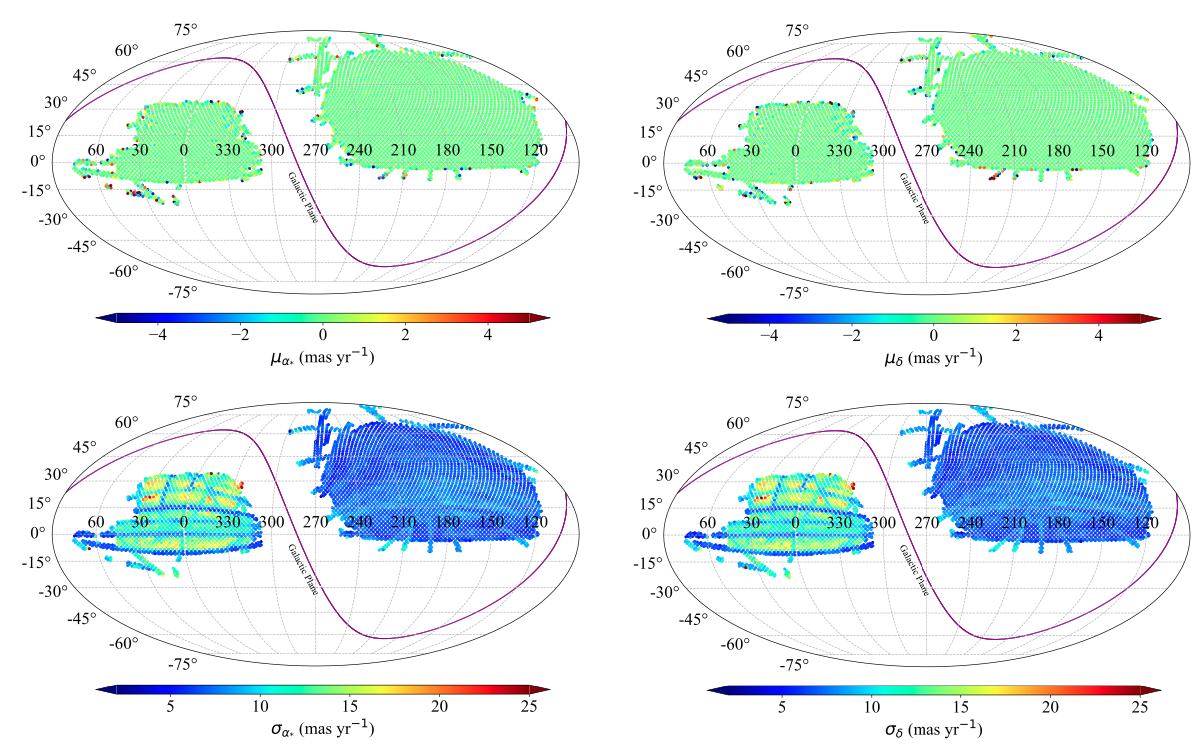
Measuring the motions of faint stars opens a window onto the distant Galactic halo. In my SDSS–DESI proper-motion study, I combined imaging observations separated by roughly 13 years, using galaxies to establish a stable reference frame. The resulting catalog extends proper-motion measurements to approximately r = 23 over 12,589 square degrees, complementing Gaia at faint magnitudes. I use these measurements together with photometric and spectroscopic information to explore halo substructures and improve the selection of distant stellar populations.

Asteroid surveys and time-domain pipelines

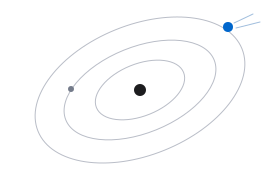
I study small Solar System bodies through wide-field, time-domain observations, with a particular interest in monitoring active asteroids. Repeated imaging can reveal unexpected brightening, faint comae or dust tails, and the onset, fading, or recurrence of activity. By combining calibrated light curves with image morphology and orbital context, I aim to distinguish dust-related activity from rotational variability, changing viewing geometry, and measurement artifacts.

A key scientific goal is to understand the mechanisms that drive asteroid mass loss, including ice sublimation, impacts, and rotational instability. Monitoring activity over time and across orbital passages can help distinguish these processes and constrain dust production, activity timescales, and the survival of volatile material. These studies connect individual objects to broader questions about the physical evolution of small bodies, the asteroid–comet connection, and the distribution of water-bearing material in the Solar System.

To support this science, I develop survey and processing workflows for SMT and GOTTA, including adaptive scheduling, matching detections to known asteroids using predicted positions, and extracting reliable photometry of moving and trailed sources. My adaptive asteroid survey scheduler connects observing cadence and field selection with visibility constraints and survey coverage, supporting repeated monitoring and timely follow-up of candidate activity.

Across these projects, I focus on careful calibration, reproducible analysis, and practical pipelines that connect large survey datasets to astrophysical questions. My collaborative work also includes CSST data-processing methods and DESI studies of galaxies and active galactic nuclei.

Skills in Programming, Observing, and Data Processing

I work primarily in Python for scientific analysis, visualization, and pipeline development, and also use Java, HTML, and LaTeX for software development, web content, and scientific writing. I routinely work in Linux environments and use high-performance computing resources, including NERSC, to process large survey datasets and run computationally intensive analyses.

I incorporate AI-assisted coding and agent-based workflows into my research software practice, using them to support task planning, code development and debugging, literature organization, documentation, and repetitive data-processing tasks. My experience includes connecting agents to command-line tools and existing analysis pipelines, while reviewing generated code and checking numerical outputs against tests and scientific expectations.

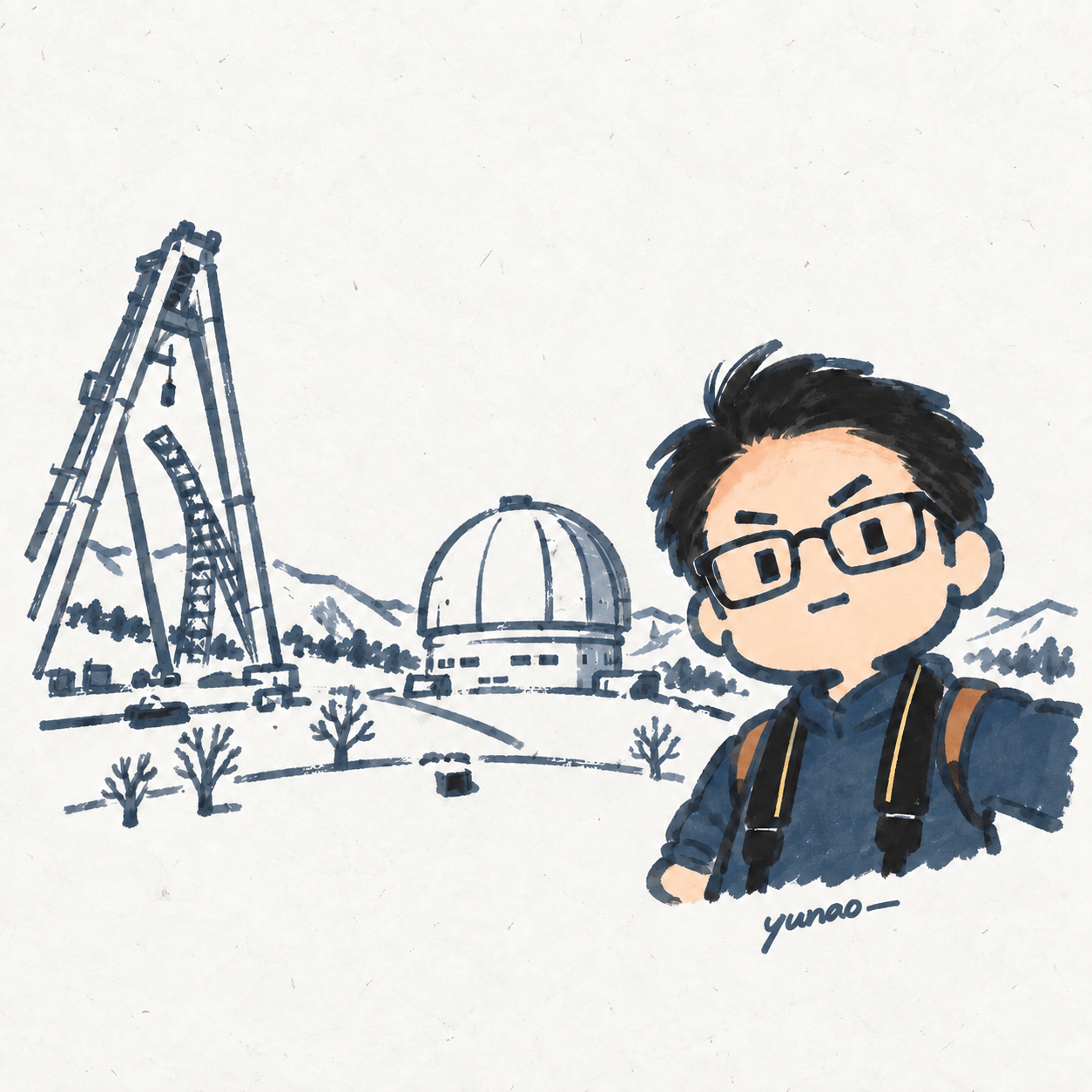
My observing experience includes telescopes across China and the 200-inch Hale Telescope (P200); I have also worked with data from the UArizona Bok 2.3-meter Telescope. I am preparing for an observing visit to the Víctor M. Blanco 4-meter Telescope at Cerro Tololo Inter-American Observatory in Chile.

I contribute to data-processing and photometric pipeline development for the Chinese Space Station Telescope (CSST), the Multi-channel Photometric Survey Telescope (Mephisto), and the 60–90 cm Schmidt telescope. This work spans image calibration, source measurement, catalog matching, and quality assessment, with an emphasis on reproducible workflows for large imaging datasets.

During my undergraduate studies, I participated in the development and testing of imaging detectors for the Cherenkov telescopes of the Large High Altitude Air Shower Observatory (LHAASO), gaining experience in instrumentation for high-energy astronomy and cosmic-ray research.

Involvement in the DESI Collaboration

I participate in the Dark Energy Spectroscopic Instrument (DESI) collaboration through observations and the analysis of survey data. Within the Milky Way Survey Working Group (MWS), my interests center on stellar streams and Galactic structure, combining spectroscopy with imaging and astrometry to study stellar populations and the Milky Way’s gravitational potential.

Our group is also actively participating in DESI-2 (DESI-II) and the Intermediate-Band Imaging Survey (IBIS). IBIS uses medium-band imaging with DECam on the Blanco telescope to help select high-redshift galaxies, including Lyman-alpha emitters and Lyman-break galaxies, for spectroscopic studies. This imaging effort supports DESI-2’s extension to higher redshift and connects survey observations and target selection to studies of large-scale structure and cosmic evolution.

Through these collaborations, I bring together experience in observing, imaging and spectroscopic data processing, and scientific analysis, linking my work on Galactic archaeology with broader survey science.

For more info

My office is located at A449, NAOC. Feel free to visit if you would like to discuss any of these topics!